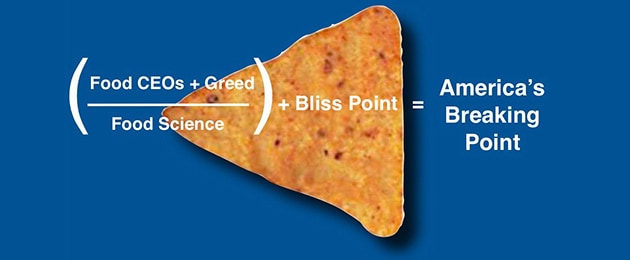
On February 24, 2013, just a few days ago, the New York Times published an extremely disturbing article written by Michael Moss, titled The Extraordinary Science of Addictive Junk Food. If you have read it, then you know what we are talking about. If you haven’t, we urge you to do so now. The article takes the reader inside the rarely disclosed underworld of food manufacturing and exposes the ugly truth about food science and the deliberate intentions of big food conglomerates to create unhealthy, addictive foods in the name of greater financial gain regardless of the health consequences to us – their consumers. It explains how armies of food scientists are instructed to get as close as possible to what is considered to be the “Holy Grail” of addictive junk food, something industry insiders refer to as “the bliss point.” By dialing in the exact flavor, color and texture that creates the greatest amount of crave, food scientists work to push consumers to ingest as much of their franken-food as humanly possible, by making it nearlyimpossible for them to put it down. The article directly reveals that these well known manufacturers are not only guilty of producing these addictive junk foods, but also knowledgeable as to how these foods are adding to the health conditions and obesity epidemic that is limiting the lifespan of our youth, and yet still relentlessly press their companies toward increased profits and market share no matter the human price.
One of the main ingredients the article points out as a commonly used tool of crave manipulation, is sugar. In Rich Food, Poor Food we identify sugar as one of our Poor Food ingredients—and explain to the reader its health depleting effects and addictive properties. The great effort required fight off a craving for sugars’ sweet taste is well documented; In fact, according to researchers out of the University of Bordeaux, refined sugar, the same ingredient added to many processed foods, is far more addictive than cocaine. This is one of the many reasons why we recommend removing it from your daily diet. It is time that we, as consumers, break free of the sugarcoated chains these contriving companies try to bind and control us with.
Additionally, when these companies want to reduce costs, and squeeze out higher profits, they often throw high fructose corn syrup (HFCS) into the mix. What they don’t want you to know is that HFCS, unlike sugar, does not trigger the secretion of leptin, a hormone that tells your brain when you are full. Because of this, eating foods that contain HFCS can lead to increased caloric consumption and obesity. HFCS consumption may also lead to an increased risk of heart disease because it has been shown to cause elevated triglyceride levels. The ramifications of a diet filled with HFCS are well documented and yet, products containing this Poor Food ingredient fill nearly every aisle in the grocery store. According to the USDA, greedy manufacturers are now filling the average American with sixty-three pounds of HFCS a year. We wonder how they can sleep at night knowing that they are profiting by selling this potentially genetically modified, corn-based inducer of obesity and heart disease to an unsuspecting public who has placed their misguided trust in them.
The deception of food science doesn't end there. There is an additional ingredient not discussed in the article, but widely used by U.S. food manufactures, which scientists worldwide recognize as an obesity inducer – Monosodium Glutamate (aka. MSG). MSG has long been used by food scientists to trick us into thinking a food tastes better than it really does. In fact, this flavor enhancer, found in nearly all processed foods in one form or another, has been shown to increase food consumption in animals by 40% and evidence suggests that it may produce similar responses in humans. MSG works so well that it is used to rapidly increase the weight of lab rats when overweight or obese rats are needed for various experiments. The food scientists hired by these unscrupulous monsters of manufacturing are well aware that like HFCS, MSG also works to induce obesity because it seems to make us leptin resistant. Recall that leptin is the hormone that makes us feel satiated. Why would you ever put down the bag of MSG-laden chips if your brain never actually receives the message to stop eating them?
The New York Times article also made it clear that the CEOs of America’s largest food companies are well aware of the fact, that the bagged, boxed and bottled products they are feverishly pushing onto society, are not only contributing to our obesity epidemic, but to the increase in diabetes and heart disease as well. In addition to everything else, MSG also causes the pancreas to secrete insulin, which drops your blood sugar quickly and makes you hungrier faster. When the body over-releases insulin, it can lead to insulin resistance, which food scientists are well aware can lead to type 2 diabetes, heart disease, and many other health problems.
Sugar, high fructose corn syrup, and MSG are all Poor Food ingredients that these companies are choosing, no, demanding be added into their products with the express intent of increasing what is known as their products “stomach share”- the amount of digestive space any one company’s brand can grab from the competition. That’s right, these manufacturers are vying for digestive space in your stomach. By following the Grocery Purchasing System (GPS) we give you in Rich Food, Poor Food you can exponentially increases food safety down every aisle of the grocery store by steering your cart towards food products that do not include these sneaky, sinister, crave-inducing ingredients. We also help you identify the numerous aliases these Poor Food ingredients are frequently hiding behind on the ingredient list.
These “Kings of Conventional Packaged Foods” need us to purchase their products in order to fill the bank accounts that supply the funds necessary to pay the food scientist to build their addictive consumer mousetraps. But we have news for them; their addictive foods cannot trap us, cause our obesity and decrease our life spans if we are educated enough not to purchase them in the first place. There is a war going on right now, and we, as a nation, need to take a stand against this type of disgusting and moralless behavior. We need to hit these manufactures where it hurts— in their bank accounts. By following the Rich Food, Poor Food Grocery Purchasing System and avoiding Poor Food ingredients and manipulative advertising you send a clear message to the food manufactures and grocery stores that they will not make money off of your ill-health. We need to cut the industry giants down to size and show them that they must be responsible for the products that they sell. As consumers we want to know that we are buying the safest, healthiest products that we can. Not products that these companies have manipulated to the point that we can’t stop eating them, but Rich Food products that add to our health in a meaningful way. While many of these “Grocery Store Gods,” like Frito-Lay, Yoplait, and Coco-Cola named in the New York Times article, feel that conning consumers with drug-like addictive foods is the way to go to increase profits, selling more with every obesity-inducing fix, are there other companies out there finding new ways to increase profits without jeopardizing the health of the American public? Is it even possible?
The answer is yes, and the good news is that food quality is now a trend that some conscientious companies are starting to pay close attention to. In 2011, the Hudson Institute, a think tank on public policy, reported that healthier foods have generated more than 70% of the growth in sales for consumer packaged-goods. In a recent Wall Street Journal article, Michelle Obama brought to our attention the fact that the mega-store Walmart, has actually increased profits by recognizing this trend and listening to consumer cravings – not for sugary fixes – but for healthier produce and packaged products. Political viewpoints and methodology aside, she has attempted to keep a focus on food quality and childhood obesity throughout her time in the White House. The article reports that over the past two years Walmart reduced the cost of fresh produce to consumers by 2.3 million dollars and cut back the sugar content in the stores by 10%. This is by no means saying that they have eliminated sugar the way we do in Rich Food, Poor Food. However, it is a definite step in the right direction. Because of this first step, Walmart has seen stronger sales in their produce departments and consumers are feeling more confident in the fact that Walmart has honest concern for their wellbeing. Disney and Walgreens are also responding to this trend. Disney has eliminated ads for junk food from its children's programming and is improving the food served in Disney theme parks and Walgreens is adding fresh fruits and vegetables to its stores in underserved communities. Using these companies as examples we can clearly see that improving the health of the public, and supplying individuals with what they need to achieve good health, rather than what they crave due to health depleting, chemical influencers, can result in increased profitability and consumer confidence for a company. This is a lesson that the sly CEOs of America’s food manufacturers should pay attention to and stop disregarding people for profits.
And it is not just large companies that can benefit from this food quality trend. Smaller companies are popping up everywhere eager to manufacture health conscious products to fill the void in the current marketplace. You will find many of these smaller food manufacturers highlighted in Rich Food, Poor Food. These companies are producing products that leave out Poor Food ingredients and instead fill their bags, boxes and bottles with high quality, health-enhancing ingredients. We are thrilled to find that as consumers are made aware of these smaller companies, grocery stores begin to offer their brands as well. It is time for a RICH FOOD REVOLUTION, a grassroots movement that puts the power of choice back in our hands, the hands of the consumers. We feel we can literally change the landscape of the current grocery stores, crowding “the bliss point” filled packages right off the shelves and replacing them with safe, healthy options for our families to enjoy.
It is also time to dispel the myth that organic food has to be more expensive and sound the alarm concerning pesticides and their new link to obesity. In a 2011 study conducted by the Mercer University School of Medicine, researchers examined whether pesticide exposure measured in the urine of subjects 6 to 19 years old played a role in global childhood obesity. Researchers found a higher prevalence of obesity in the youth with high urinary concentrations of a pesticide known as 2,5-dichlorophenol (2,5-DCP) – one of the most widely used pesticides on the globe. But, GMO-monger Monsanto and other opponents of organic farming scream that growing organically would increase cost and decrease production. To this we cry FOUL! Recently, the 30-yearcomparative study of organic and conventional growing methods, carried out by the Rodale Institute revealed that the yield on organic and conventional plots showed no difference whatsoever in overall corn, soy or wheat production per acre. And, in years of drought, yields in organic plots were 30% higher than those in conventional plots. Rodale’s study even indicates that organic produce is more cost effective for farmers to grow than conventional produce. That’s right. Buying organic produce should be saving you money! It turns out that organic farms are almost twice as profitable as conventional ones! According to Mark Smallwood, the executive director of Rodale, there simply are not enough organic farms yet to bring down the prices (simple supply and demand). As our awareness of the ramifications of conventional growing increase, the number of organic farms will grow as well, and the prices will drop (along with the pounds being added due to pesticide toxicity.)
Finally, to those critics who say producing and purchasing healthy food is just too expensive, we share Michelle Obama’s words, “We spend $190 billion a year treating obesity-related health conditions like diabetes and heart disease, and a significant portion of those costs are borne by America's businesses. That's on top of other health-related costs like higher absenteeism and lower worker productivity, costs that will continue to rise and threaten the vitality of American businesses until this problem is solved once and for all.” Shame on those food manufactures pointed out in the New York Times article and others like them for not caring about the injury they are inflicting on the health of humanity by pushing their additive drug–like food products on the global population. Your reckless pursuit of the almighty dollar and the abominations you call food, scientifically engineered to reach the maximum “bliss point,” making it so that a typical consumer is no longer able to control their own food choices, are exactly what has pushed the entire American population to it’s “breaking point!” We hope the food scientists who create these colossal cravings read this and recognize the disservice they are doing to their families, friends and the nation. We applaud the companies, like Walmart, Disney, and Walgreens who are striving to meet the desires of the consumer by implementing conscientious advertising and offering healthier options in their stores and theme parks. And leaders like Michelle Obama who are bringing the issue of food quality and childhood obesity to the forefront. But we must do more if we want to turn around the health crisis America currently faces.
There is a plague among us that must be eradicated; it is no longer lurking in the shadows behind closed doors. It has been exposed through the brave words of Michael Moss and it is up to us to do something about it. Real change will start with you. So get out your flag of personal responsibility and start waving it. Step up and join the Rich Food Revolution, educate yourself and take control of your health through calculated action. This will not be a battle easily won, but it is a battle that must be fought if we are to save ourselves, and our children from the health conditions and diseases inflicted by the extraordinary science of addictive junk food.